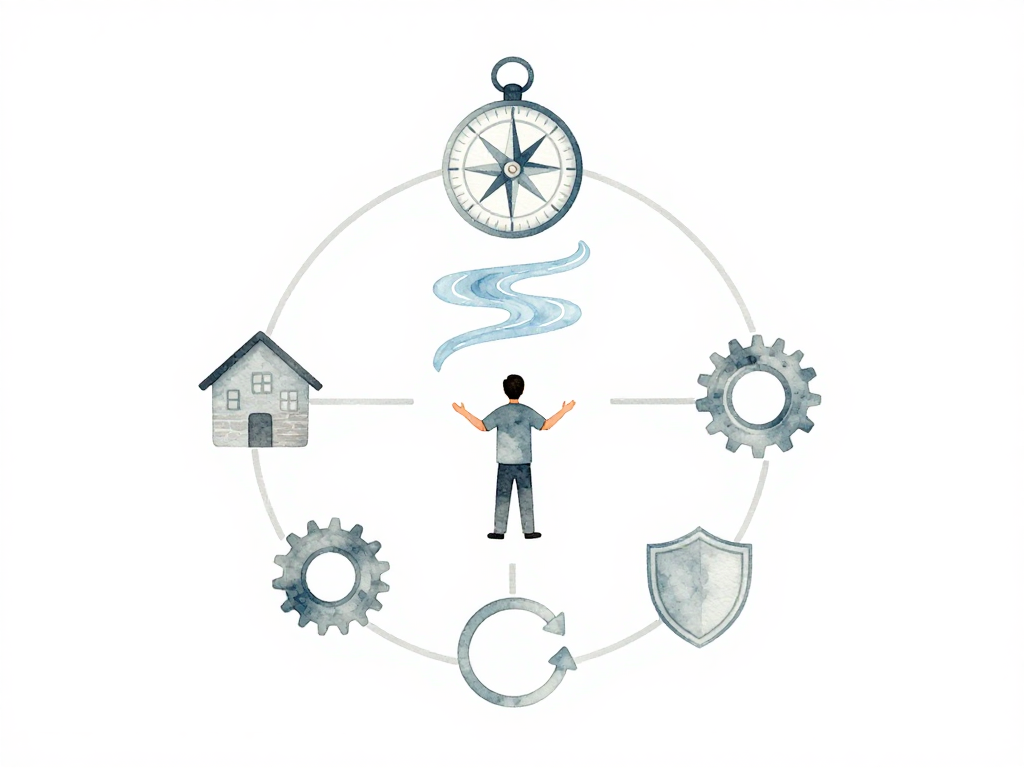
The Big Picture: How an Integrated Delivery Operating Model Actually Works
You have a team that can deploy quickly. You have a platform team building internal tools. You have pipelines that run tests automatically. You have governance policies written somewhere in a document. And you still have releases that feel chaotic.
What's missing is not another tool or another process. What's missing is the connection between all these pieces. When business goals, team structure, platform capabilities, deployment strategies, and governance policies operate in isolation, each piece might look good on its own, but the whole system doesn't deliver.
This is where an integrated delivery operating model comes in. It's not a diagram you hang on the wall. It's a way of making sure every part of your delivery system exists because it serves something else, and every part feeds back into improving the whole.
Start With Why: Business Outcome at the Top
Every delivery system exists to achieve something. That something is a business outcome: faster time to market for a new feature, higher reliability for a critical service, or the ability to scale to more users without breaking.
If you don't start here, everything else becomes activity without direction. A faster pipeline is useless if it's delivering the wrong thing. A sophisticated deployment strategy is wasted if the team is working on a feature nobody needs.
The business outcome sits at the top of the model. It answers the question: why are we doing any of this?
Value Stream: The Path From Idea to User
Once you know what you want to achieve, you need to map how work actually flows from an idea to something users can use. This is your value stream. It includes every step: discovery, design, development, testing, deployment, and monitoring.
The value stream is not the same as your team structure. Many organizations confuse the two. They think because they have a team called "platform" and a team called "applications," the value stream is just handoffs between them. In reality, the value stream reveals where work gets stuck, where waiting happens, and where quality problems originate.
Team Topology: Who Does What
With the value stream clear, you can decide who builds what and who maintains what. This is team topology. Some teams own end-to-end services. Some teams build platforms that other teams use. Some teams focus on enabling others to move faster.
The topology should follow the value stream, not the other way around. If your teams are organized around technology layers (frontend team, backend team, database team), but your value stream requires fast end-to-end delivery, you will have friction at every handoff.
Platform Engineering: The Foundation, Not a Tool Collection
Platform engineering sits alongside the value stream. It provides the technical foundation that teams use to build, test, and deploy. But a platform is not just a list of approved tools. It is a layer of capabilities that teams can consume without rebuilding infrastructure every time.
A good platform reduces cognitive load for application teams. They don't need to think about Kubernetes clusters, database provisioning, or CI/CD pipeline maintenance. They think about their product. The platform team thinks about how to make that experience smoother.
Pipeline: The Path From Code to Production
On top of the platform, CI/CD pipelines carry changes from code commit to production. Each pipeline has a deployment strategy chosen based on risk and the nature of what is being delivered.
A simple web application might use a rolling update. A database migration might require a blue-green deployment. A critical payment service might need canary releases with automatic rollback. The pipeline is not one-size-fits-all. It adapts to what it's delivering.
Governance and Verification: Rules Embedded, Not Attached
Governance is often treated as a separate layer: someone writes a policy, someone else checks compliance, and everyone feels slowed down. In an integrated model, governance is embedded in the pipeline. Every change passes through verification gates before moving to the next stage.
These gates can be security scans, compliance checks, performance tests, or manual approvals for high-risk changes. If a gate fails, the change stops there. If all gates pass, the change proceeds to production using the chosen deployment strategy.
The key difference is that governance is not a document. It is a mechanism that runs automatically as part of delivery. Teams don't need to remember to check policies. The system enforces them.
Improvement Loop: Closing the Circle
After a change reaches production, the model does not stop. Data from every release is collected: how long delivery took, which gates failed most often, whether the deployment strategy worked as expected, and whether the business outcome was achieved.
This data feeds back into every part of the model. Maybe the platform needs a new capability. Maybe the governance policy is too strict for low-risk changes. Maybe the team topology creates unnecessary handoffs. The improvement loop ensures the model learns from experience.
How the Pieces Connect
The model is integrated not because all components exist, but because each component explicitly connects to others:
The following flowchart captures these connections in a single view:
- Business outcome determines which value stream gets priority.
- Value stream determines team topology.
- Team topology determines what platform capabilities are needed.
- Platform capabilities determine what pipelines can be built.
- Pipelines determine which deployment strategies are available.
- Governance and verification ensure safety at every step.
- Improvement loop feeds everything back to business outcome.
When delivery is slow, you can trace the problem. Is it the pipeline? The platform? Governance that is too tight? Or a value stream that is inefficient? When production issues increase, you can check whether verification gates are sufficient or whether the deployment strategy needs to change.
Practical Checklist for Your Team
Use this to assess where your delivery system has gaps:
- Can every team member explain what business outcome their work supports?
- Is your value stream mapped, and do you know where work gets stuck?
- Does your team topology follow the value stream, or does it follow technology layers?
- Does your platform reduce cognitive load, or does it add complexity?
- Are governance policies embedded in the pipeline, or are they manual checklists?
- Do you collect data from every release and use it to improve?
The Model Lives and Changes
An integrated delivery operating model is not a document you write once. It evolves as your organization learns. Each delivery cycle brings information that can adjust the model. Teams can change deployment strategies as risk profiles shift. Platforms can add capabilities as new needs emerge. Governance can be updated when security gaps are detected.
When everyone sees the same picture, decisions become easier. Application teams understand why they must follow certain governance rules. Platform teams know what to build next. Management can see whether investments in platform and pipeline are producing the expected business outcomes.
Everyone moves in the same direction, not because they are forced to, but because every part of the model supports every other part.