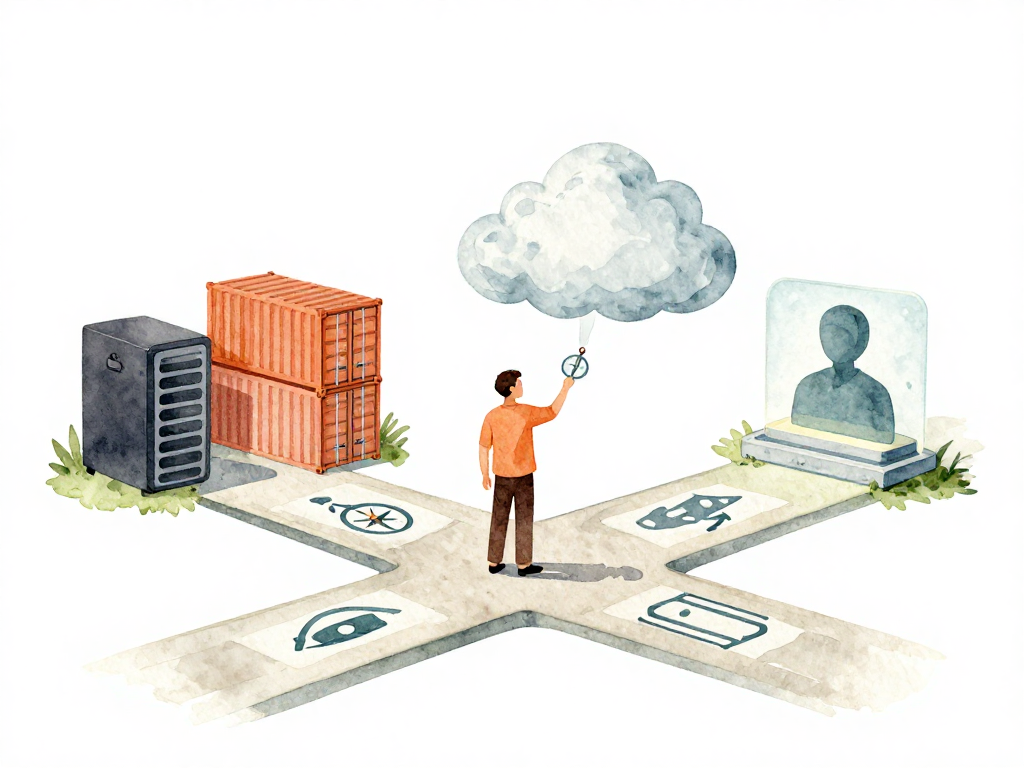
Where Will Your Application Run? Server, Container, Serverless, or Edge
You have built an application. It works on your laptop. Now you need to put it somewhere other people can use it. That simple question -- "where will this application live?" -- shapes everything about how you build, test, and ship your software.
The answer is rarely just one thing. Maybe your application runs on a physical server in a closet at the office. Maybe it runs on a virtual machine in the cloud. Maybe it is packaged as a container managed by Kubernetes. Maybe it runs as a serverless function that only exists when someone calls it. Or maybe it needs to run at the edge, close to the user, on an IoT device or a network node.
Each of these targets changes how you design your CI/CD pipeline. The tooling matters, but the deeper question is about what your pipeline needs to handle. Let's walk through each target and see what shifts.
Deploying to Servers: Physical or Virtual
When you deploy directly to a server, your pipeline needs to handle the full stack. You are not just shipping code. You are shipping an application that needs a specific operating system, specific middleware, specific versions of libraries, and specific configuration files.
Your build process typically produces a binary, a package, or a set of files. Your pipeline then transfers those files to the server, installs them, and restarts the application. Rollback means replacing files or reverting to a previous version on the same machine.
The pipeline for server deployments tends to be longer. You need steps for provisioning the server, installing dependencies, configuring the environment, and verifying that everything works together. If you manage multiple servers, you also need to coordinate updates across them.
The advantage is control. You decide exactly what runs on the machine. The disadvantage is that every server becomes a snowflake. Small differences between environments -- a slightly different library version, a config file that was edited manually -- can cause problems that are hard to reproduce.
Deploying to Containers
Containers change the game. Your application and all its dependencies are packaged into an image. That image is built once and deployed everywhere. The environment inside the container is consistent across development, testing, and production.
Your pipeline shifts focus. Instead of managing server configuration, you focus on building the image, storing it in a registry, and deploying it to an orchestration platform like Kubernetes. Rollback becomes simpler: you just point to a previous image version.
But new challenges appear. You need to ensure the image is secure. You need to manage image versions and tags. You need to update running containers without disrupting traffic. You also need to handle stateful components like databases, which do not fit neatly into the container model.
Containers give you consistency and portability. But they require understanding of container runtimes, orchestration, and networking. Your team needs to learn how to debug issues that happen inside a container, not just on a server.
Deploying to Serverless
Serverless takes the abstraction further. You do not think about servers at all. You write a function, upload it to a platform, and the platform handles execution, scaling, and availability.
Your pipeline becomes simpler in some ways. You just need to package your function code and deploy it. There is no server to provision, no operating system to configure, no container to manage.
But the challenges shift to other areas. How do you manage function versions? How do you configure environment variables and secrets? How do you test your function when the execution environment is not fully under your control? How do you handle cold starts, where a function takes longer to respond because it has not been called recently?
Serverless works well for event-driven workloads, APIs with variable traffic, and tasks that run intermittently. It reduces operational overhead but limits your control over the runtime environment.
Deploying to the Edge
Edge deployment adds a different kind of complexity. Your application needs to run in many locations, often with limited resources. Think of IoT devices, routers, CDN nodes, or retail point-of-sale systems.
Your pipeline must handle distributing updates to thousands or millions of devices. Some devices might be offline when you push an update. Some might have unreliable network connections. Some might run on hardware that you cannot replace easily.
Rollback at the edge is hard. You cannot just flip a switch and revert all devices at once. You need strategies for gradual rollouts, for handling devices that miss updates, and for recovering devices that fail after an update.
Edge deployment is not just about software. It is about logistics. How do you ensure that a device in a remote location gets the right version? How do you monitor devices that are not always connected? How do you handle devices that run out of storage or memory?
The Target Is Not Permanent
Here is the thing: your deployment target is not a permanent decision. The same application can move between targets over time. You might start with a physical server, move to a virtual machine, then to containers, and later split parts of the application into serverless functions.
Each move changes your pipeline. The build process changes. The deployment strategy changes. The rollback mechanism changes. The monitoring and observability requirements change.
The key is to understand what each target requires from your pipeline, not just what tools to use. When you know the implications, you can design a pipeline that matches your actual needs, not just the latest trend.
Practical Checklist for Choosing a Deployment Target
Before you commit to a target, run through these questions:
The following flowchart can help you visualize how your answers to those questions lead to a deployment target.
- Where does your team have the most experience? A team that knows servers well will struggle less with server deployment than with Kubernetes.
- How much control do you need over the runtime environment? More control means more pipeline complexity.
- How will you handle rollback? Some targets make rollback easy (containers), others make it painful (edge devices).
- How will you test the deployment? Serverless and edge environments are harder to replicate locally.
- What is your traffic pattern? Steady traffic favors containers or servers. Spiky traffic favors serverless.
- How many instances do you need to manage? A few servers are manageable. Thousands of edge devices require a different approach.
What Matters Most
The deployment target determines the shape of your pipeline. It decides what your build produces, how your tests run, how your updates reach users, and how you recover from failures.
Choose based on your application's needs, your team's capabilities, and your operational reality. Not because containers are popular or serverless is the future. The right target is the one you can operate reliably, update safely, and debug effectively when things go wrong.
Your pipeline should reflect that choice, not fight against it.