Learning from Every Delivery: Closing the Improvement Loop
You just shipped a release. The pipeline was green, the deployment went smoothly, and users are happy. Or maybe it was a disaster: a failed migration, a rollback at 2 AM, and a post-mortem that blamed "process issues." Either way, the release is done. Now what?
Most teams treat the end of a release as the finish line. They move on to the next feature, the next sprint, the next fire to put out. But every release -- successful or not -- carries valuable information. Not just about whether the new version works, but about how the delivery process itself performed. Which steps were slow? Which checks failed repeatedly? Which rules turned out to be irrelevant? Without a mechanism to capture and act on this information, your delivery model stays frozen at its current level of maturity.
The Data You Already Have
After a release, you don't need a fancy dashboard to start learning. You need answers to a few basic questions:
- How long did it take from the first commit to production?
- How many builds failed along the way?
- How much time did the team spend waiting at approval gates?
- Were there manual steps that could have been automated?
- Did any incidents happen after the release?
This data is usually scattered across your CI/CD tool, your incident tracker, and your team's chat history. The first step is to collect it in one place. It doesn't need to be a polished report. A shared document or a simple spreadsheet works. What matters is that you look at the numbers honestly.
Three Layers to Improve
Once you have the data, you can decide where to focus. Improvement works across three layers:
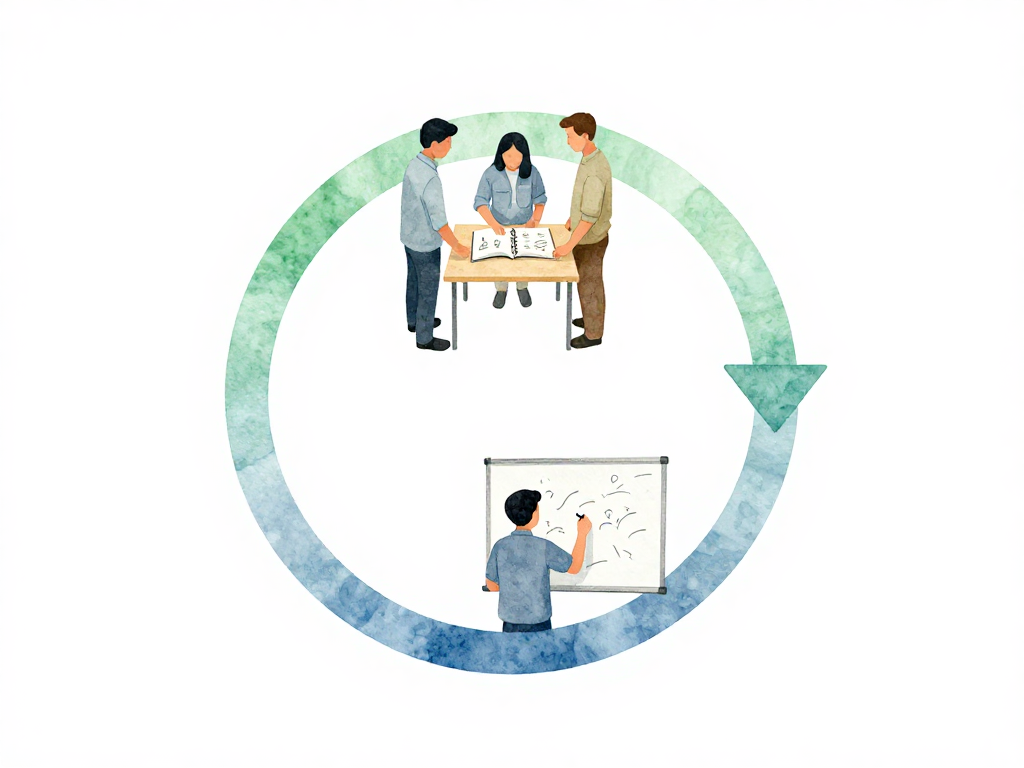
The diagram below illustrates how the improvement loop connects releases to the three layers of improvement.
Process covers how the team works: the sequence of steps in the pipeline, how decisions are made, who needs to approve what, and how handoffs happen between teams.
Platform covers the tooling and infrastructure: the CI/CD system, testing environments, deployment scripts, and monitoring tools.
Policy covers the rules: governance gates, verification criteria, and the conditions that must be met before a release can proceed.
A slow release might be a process problem (too many manual approvals), a platform problem (build servers are underpowered), or a policy problem (a gate that checks something irrelevant). Often it's a combination of all three.
Learning from Success, Not Just Failure
It's natural to focus on failures. A broken release demands attention. But success is equally instructive.
When a release goes smoothly and quickly, ask why. Maybe the change was small and focused. Maybe the team had the right tests in place. Maybe the staging environment was finally a close match to production. Whatever the reason, that's a pattern worth reinforcing.
When a release goes badly, the temptation is to add more gates, more checks, more approval steps. But sometimes the problem isn't too little control -- it's too much. A gate that never catches real issues just adds delay. A test that always passes gives false confidence. The improvement loop should prune what doesn't work, not just add what might.
Closing the Loop Between Teams and Platform
In many organizations, there's a gap between the teams that deliver software and the platform team that builds the tooling. The platform team adds features based on assumptions. The delivery teams work around limitations silently. The improvement loop bridges this gap.
When a delivery team finds that a pipeline step is consistently slow, they report it to the platform team. The platform team investigates and fixes the infrastructure or tooling. When the platform team rolls out a new feature, the delivery teams test it and report whether it actually helps or just adds complexity.
This two-way feedback keeps the platform relevant. Without it, platform teams build things nobody uses, and delivery teams suffer with tools that don't fit their needs.
Make It Part of the Release, Not a Separate Meeting
The improvement loop should not be a monthly retrospective that sits outside the delivery cycle. It should be embedded in every release.
After each production deployment, schedule a short review. It doesn't need to be a formal meeting. A 15-minute chat with the people involved, looking at the data, and agreeing on one or two changes for the next release is enough. The key is consistency. If you only review after major incidents, you miss the small improvements that compound over time.
A Practical Checklist for Your Next Release Review
Before you close out your next release, run through these questions:
- What was the total lead time from commit to production?
- How many builds failed, and why?
- Were there any manual steps that delayed the release?
- Did any verification gate fail to catch a real issue?
- Did any verification gate pass without actually checking anything useful?
- Was there an incident after release? If so, could it have been caught earlier?
- What went better than expected? Why?
- What one change would make the next release faster or safer?
Pick one item from this list and act on it before the next release. Not all of them. One.
The Takeaway
Every release is a data point. The improvement loop turns that data into better processes, better platforms, and better policies. It doesn't require a big initiative or a dedicated team. It requires a habit: after every delivery, ask what you learned, and make one small change based on the answer.
Your delivery model should not be static. It should grow with every release. Not because you plan a big transformation, but because you pay attention to what each delivery teaches you.